
Australian passport photo size (APO millimetre rules)
Australian passport photos follow Australian Passport Office (APO) size and composition rules on passports.gov.au—not US 2×2 squares and not identical to every UK print. Outer print size sits in a millimetre range, chin-to-crown height is tightly specified, and print paper quality matters for biometrics. This guide explains what to measure before you crop, why many shops still talk about “35×45,” and how AU sizing differs from UK and US crops. Confirm the current Photo Guidelines on passports.gov.au before you lodge.
Official APO photo dimensions
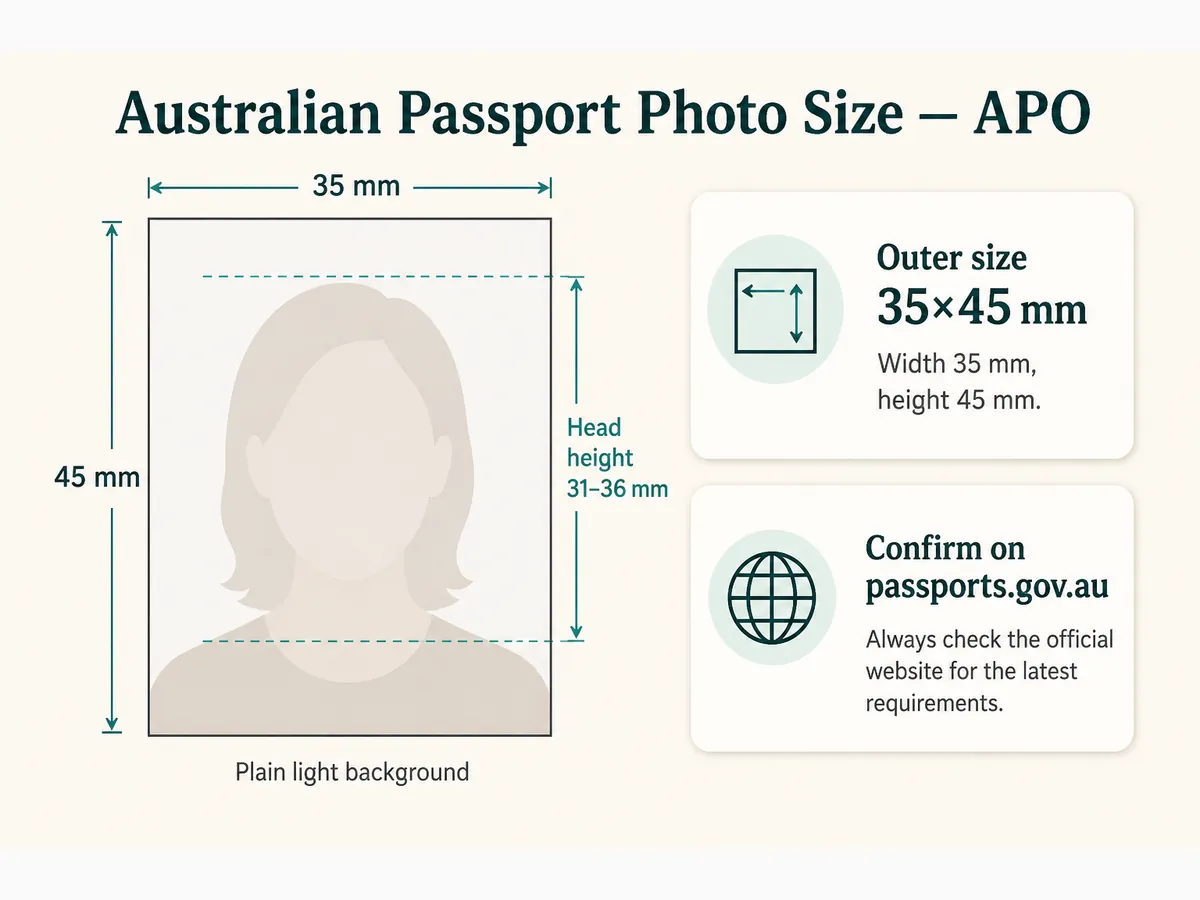
APO states your photos must be 35–40 mm wide and 45–50 mm high. That is a short range, not a single fixed pair of numbers—booths and labs usually aim for a common size inside that box.
Inside the frame, the height of your face from chin to crown must be 32–36 mm. That measurement drives biometric matching. Outer size can be “close enough” while head height is still wrong—so measure both.
Applications typically need two good-quality identical colour prints less than six months old. Professional providers are recommended, but every photo is still checked against the guidelines—paying a shop does not skip review.
- Print size: 35–40 mm wide × 45–50 mm high
- Chin-to-crown: 32–36 mm
- Two identical colour prints (usual requirement)
- Taken within the last six months
Chin-to-crown 32–36 mm in plain language
Imagine a vertical ruler on the print from the bottom of the chin to the top of the head (crown), including hair volume as it appears. That distance must land between 32 and 36 mm—tighter than many travellers expect. On the APO poster diagram, that vertical dashed line is the measurement reviewers care about most—treat it as non-negotiable even when the outer rectangle looks close enough.
If the face looks tiny with large empty margins, head height is probably under 32 mm. If the crown or chin feels clipped, you may be over 36 mm or the outer crop is wrong. Re-crop with guides rather than trimming unevenly with scissors.
Hair across the eyes or a heavy fringe can make head height look wrong even when millimetres are fine. Pin hair back so facial features stay clear for biometric systems.
Why this tool (and many shops) use 35×45 mm
Most Australian booths and photo counters output 35×45 mm—a size that sits inside APO’s published range and matches many Schengen visa prints. Our free cropper uses a practical 35×45 AU template so you can align head height before you print.
If a lab offers “passport size,” say you need Australian passport size per current APO guidance, including the 32–36 mm chin-to-crown band—not a US 2×2 or a tourist “ID colour” product.
Always re-open passports.gov.au if APO updates ranges. Tool presets help composition; official millimetres remain the authority at lodgement.
- 35×45 mm is a common in-range print size
- Still verify chin-to-crown 32–36 mm after printing
- Ask shops for APO Australian passport size by name
- Keep the uncropped original for a second attempt
Australia vs UK vs US — same words, different rules
US photos are a 2×2 inch square with a white or off-white background and an inch-based head band. Do not stretch a US file into an AU rectangle.
UK photos are also often 35×45 mm, but UK printed guidance emphasises cream or light grey backgrounds and a 29–34 mm crown-to-chin band. Australia uses white or light grey and a 32–36 mm chin-to-crown band. Same outer label does not mean interchangeable prints.
Paper quality differs too. APO looks for high-quality colour prints on heavy-weight glossy paper (guidance cites a minimum around 200 gsm). UK and US paper notes are worded differently—follow APO for Australian lodgement.
- AU: 35–40 × 45–50 mm range; chin–crown 32–36 mm
- UK: typically 35×45 mm; crown–chin 29–34 mm; cream/light grey prints
- US: 2×2 inch square; different head and background rules
- Never assume one country’s print works for another
Background, lighting, and print paper
Use a plain white or light grey background with even lighting—no shadows on the face or behind the head. Dark, patterned, or busy backgrounds fail biometric capture. Soft shadows under the chin from a single overhead bulb are easy to miss on a phone screen and obvious on glossy paper at the counter.
Stand far enough from the wall that your head does not cast a silhouette. Soft, even light from the front beats harsh midday sun or a single overhead bulb.
Inkjet home prints and light office paper often fail quality checks. APO emphasises heavy-weight glossy photo paper. If you DIY the digital crop, still print through a lab that understands passport paper weight.
Expression, glasses, and head coverings
Face the camera with a neutral expression and mouth closed. Eyes open and clearly visible. Wide smiles are a frequent refuse reason even when size is perfect.
Glasses should not hide the eyes or show glare; many applicants remove them to be safe. Head coverings only when allowed for religious or medical reasons with the full face visible.
No filters, retouching, or shadow-removal edits that change facial features. APO has publicly warned that even “small” digital fixes can break biometric matching.
Measure before you lodge (Officeworks, Post, lab)
After printing, put a ruler on one copy: confirm outer width/height fall in 35–40 × 45–50 mm and chin-to-crown sits in 32–36 mm. If either fails, fix the digital crop and reprint—do not trim one edge hoping it “looks close.” If you are lodging at Australia Post or a passport interview, damaged corners or sticky residue from tape can force an on-the-spot reprint—carry a spare pair when you can.
Name your file clearly (for example au-passport-crop.jpg) when uploading to a kiosk so staff do not open a US or UK preset. Tell them the file is already sized for Australian passport prints.
Carry two identical prints plus a spare when you can. Counter staff may refuse a damaged or soft print and ask for a new set on the spot.
- Ruler-check outer size and head height
- Print at 100% scale—no “fit to page”
- Heavy glossy photo paper meeting APO guidance
- Two identical copies for lodgement
Common Australian size mistakes
Size and quality failures often arrive together. A correctly measured soft print still fails. Start from a sharp, evenly lit original.
- Submitting a US 2×2 square
- Using a UK cream-background print without checking APO rules
- Chin-to-crown outside 32–36 mm
- Light inkjet paper instead of heavy glossy stock
- Smiling or filtered photos that still measure correctly
- Cutting prints freehand after a wrong crop
Pre-lodge AU size checklist
If any checklist item fails, reprint before you travel to lodge. Replacing photos mid-application costs time and often a second trip. A five-minute ruler check at home is cheaper than discovering a millimetre error after you have already queued.
- Outer print in the 35–40 × 45–50 mm range
- Chin-to-crown between 32 and 36 mm
- Plain white or light grey background, even light
- Neutral expression; no heavy digital retouching
- Two identical glossy prints under six months old
- You confirmed passports.gov.au Photo Guidelines
Ready to crop your photo?
Free online tool—pick your country template (US 2×2 or UK 35×45), align your head, and download. No account needed.