
Can you smile in a US passport photo?
US passport photo guidance allows a natural smile if your mouth stays closed and your eyes stay open—exaggerated grins that show teeth are the high-risk pattern. Official pages also describe a neutral expression facing the camera. This guide explains the practical gap between “natural closed-mouth smile” and “toothy grin,” how reviewers read the face, brief notes for UK and other destinations, and how to check your crop before upload or print. Always confirm the latest wording on travel.state.gov for your application.
Neutral vs smile: what US rules actually say
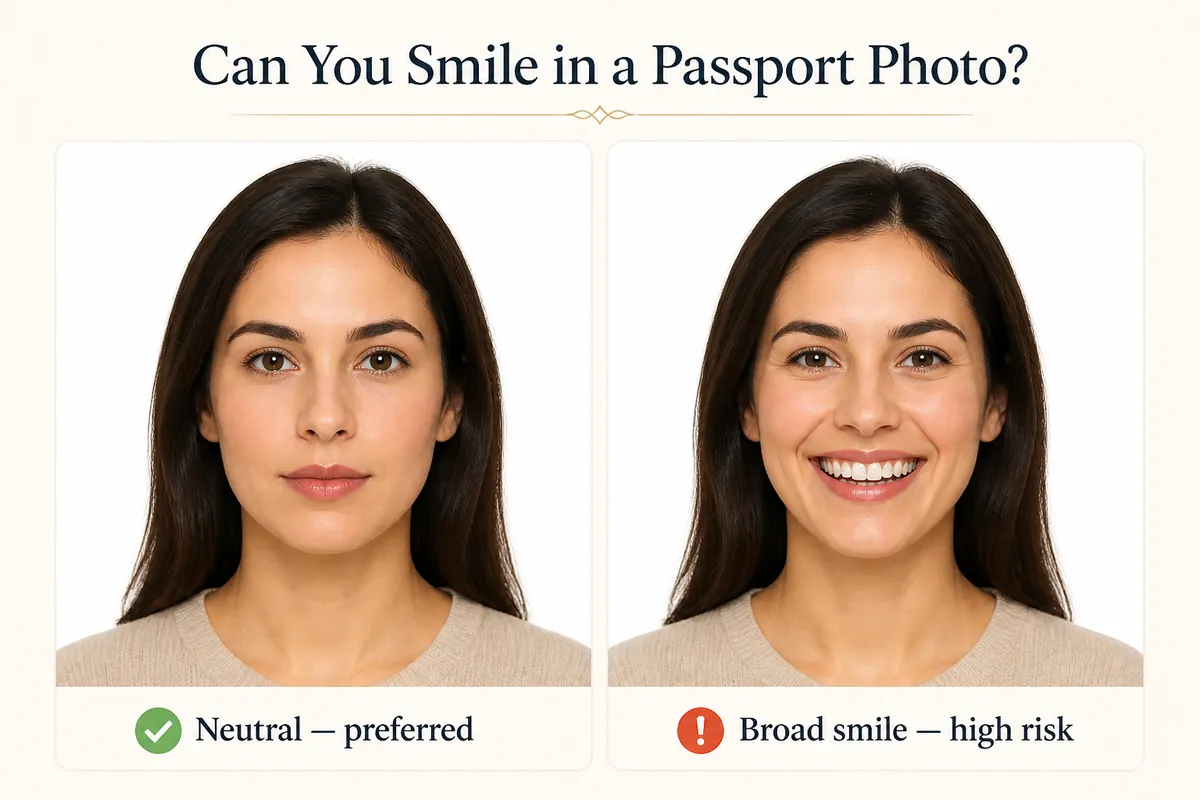
On travel.state.gov, pose guidance asks you to face the camera with a neutral expression, both eyes open and visible, and mouth closed. Separate pose text also states you can smile if eyes stay open and the mouth stays closed—avoid exaggerated expressions.
In practice, that means a calm face or a very slight closed-mouth smile is the low-risk zone. A wide smile that shows teeth, changes cheek shape heavily, or narrows the eyes is the zone that commonly fails automated checks or human review.
When you are unsure, choose fully neutral. It is easier to pass a plain expression than to argue that a grin was “natural.”
- Low risk: neutral face, mouth closed, eyes open
- Moderate risk: tiny closed-mouth smile, eyes still clearly open
- High risk: teeth visible, laugh, squint, or exaggerated expression
- Always face the camera; do not tilt for a “better smile”
Why big smiles fail more often
Reviewers and automated systems need a clear, consistent view of your face. A big smile changes mouth shape, can cast shadows, and can hide the edges of the face. Squinting reduces visible iris area.
Phone selfies encourage a social-media smile. Passport photos are identity documents. Aim for a calm everyday look that still resembles how you appear without posing for likes.
If friends say “you look happier smiling,” that advice is for portraits—not for US passport submission. Keep a second smiling snapshot for yourself if you want; submit the compliant frame.
Automated online checks are especially sensitive to teeth and eye closure. A frame that looks friendly on a phone lock screen can still fail the upload tool. Prefer the calmer take every time.
Glasses, hair, makeup, and clothing (expression traps)
Everyday makeup that reflects your normal appearance is usually fine. Heavy filters, skin-smoothing apps, or edits that reshape the face are not. Submit an original unedited photo after a size crop only.
For US passport photos, remove eyeglasses, sunglasses, and tinted lenses unless you have a rare documented medical exception with the required statement. Glare and frames that hide the eyes make expression impossible to judge fairly.
Do not rest sunglasses on your head in the frame. Do not look away “to soften the smile.” Shoulders square, face forward, mouth closed.
- Move hair off the eyes so the expression can be seen
- Head coverings only for allowed religious or medical reasons, face fully visible
- Avoid white tops that blend into a white background
- No uniforms or camouflage except where rules allow daily religious attire
Babies and young children
Infants are not expected to hold a perfect adult neutral face, but a wide-open mouth or a screaming expression is still a problem. Eyes should be open when possible. No pacifiers, bottles, or supporting adult hands in the frame.
Older children who can follow directions should use the same adult expression rules: calm face or slight closed-mouth look, eyes open, facing the camera.
Country nuances (brief)
United States: prefer neutral or natural closed-mouth smile; no teeth; confirm on travel.state.gov. United Kingdom: GOV.UK also expects a plain expression without a wide smile for adult photos—check the current GOV.UK photo rules for your case.
Other countries vary. Some visa photos are stricter about “no smile at all.” Never reuse a grinning social photo for a foreign form just because a US page allows a natural closed-mouth look. Match the destination’s official page.
- US passport / many US visas: closed mouth; natural smile may be OK if not exaggerated
- UK: follow current GOV.UK expression guidance for adults and children
- When filing two countries the same week: shoot a neutral set first
How to check before you submit
Crop to 2×2 inches first, then view the mouth and eyes at 100% zoom on a larger screen if you can. If teeth show, or the mouth is clearly grinning, retake. A free cropper fixes size; expression still comes from the original shot.
Ask a friend to review the crop on a desktop monitor. Phones hide small grins that reviewers catch on a brighter, larger display.
For online renewal, a rejected expression means another upload. For mail-in, bad prints waste postage and time. One careful retake is cheaper than a delay.
Quick expression checklist
If any item fails, retake before you pay fees or mail forms. Do not “fix” a grin with editing tools.
- Mouth closed; lips relaxed
- Eyes open and looking at the camera
- No exaggerated smile, laugh, or squint
- No filters that change facial shape
- Face forward, head not tilted
- Hair not covering eyes
Visa and ID photo note
Many US visa photos also expect a 2×2 format with a neutral or natural closed-mouth look. Always open the instructions for the exact form you are filing.
Driver’s license or Real ID portraits follow state DMV processes—not passport crop tools. Do not assume a passport expression photo substitutes for a DMV capture.
Practical retake tips at home
Stand a few feet from a plain white or off-white wall. Use soft front light. Put the camera at eye level. Take five frames: three fully neutral, two with the tiniest closed-mouth smile. Pick the calmest frame that still looks like you.
Our free browser tool helps with US 2×2 framing. It does not replace official review. When in doubt, submit the neutral frame.
Practice shots before the real crop
Do a thirty-second rehearsal: sit or stand in the final light, look at the camera, close your mouth, and relax your forehead. Then shoot. Rehearsal prevents the last-second social smile that shows teeth.
If you normally raise your eyebrows when you smile with your eyes, keep brows soft and shoulders still. Exaggerated brow movement can look like an unacceptable expression even when the mouth is closed.
- Take a neutral set first, then optional tiny closed-mouth frames
- Review on a laptop before you upload
- Retake rather than edit if teeth appear
Ready to crop your photo?
Free online tool—pick your country template (US 2×2 or UK 35×45), align your head, and download. No account needed.