
Who can sign a UK passport photo (countersignatory rules)
Some paper UK passport applications need a countersignature on the back of one photo—someone who knows you confirming it is a true likeness. Online GOV.UK digital uploads usually do not use this paper step. This guide explains when a countersignatory is required, who typically qualifies, what they write, and common mistakes that delay postal applications. Profession lists and form rules change: always read the current GOV.UK guidance for your exact application type before you ask anyone to sign.
When a countersignature is required (and when it is not)
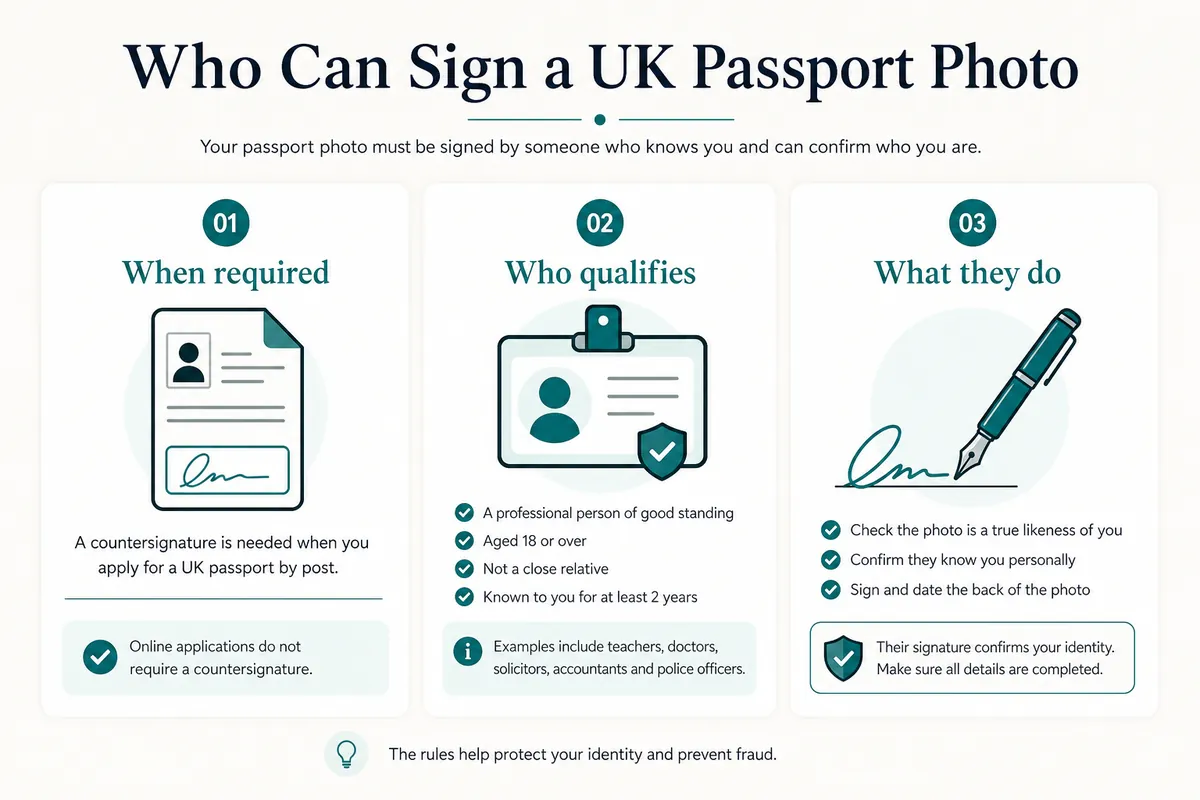
Countersigning applies to selected paper applications—commonly some first adult passports, certain renewals, or applications where GOV.UK says a countersignatory is needed. It is not a universal step for every UK passport.
Online applications that upload a digital photo typically rely on the official photo check and identity steps described for that channel—not a handwritten note on a print.
Open your form instructions on gov.uk first. If countersigning is not listed, do not invent a signature “just in case”—writing on a photo can waste a good print.
- Check your exact paper or online form on GOV.UK
- Online digital routes usually skip paper countersigning
- When required: one photo signed on the back
- Second print stays clean and identical
Who can be a countersignatory (core rules)
GOV.UK sets rules along these lines: the person must have known you personally for at least two years, be able to identify you, hold an eligible profession from the official list, and must not be related to you or living at your address.
They confirm the photo is of you. They do not approve the passport—that decision stays with HM Passport Office.
“My manager knows me” is not enough if their job is not on the accepted list or they have not known you for two years. Job title alone does not override GOV.UK eligibility.
- Known you personally for at least 2 years
- Eligible profession on the current GOV.UK list
- Not a relative; not living at your address
- Able to recognise you in the photo
Professions that often appear on the GOV.UK list
Official lists commonly include categories such as certain teachers and lecturers, medical doctors and dentists, accountants, solicitors and barristers, police officers, civil servants of specified grades, ministers of religion, and other regulated professionals. Treat any blog list—including this summary—as illustrative only.
The accepted occupations are updated on GOV.UK. An occupation that worked for a friend last year might not match today’s wording. Open the live “countersignatory” / “someone who can confirm your identity” pages when you apply.
Professionals must usually be practising (or meet whatever active-status wording GOV.UK currently uses). If someone recently retired, verify whether they still qualify—do not guess.
- Education: teachers / lecturers (when listed)
- Health: doctors, dentists, and similar listed roles
- Legal / finance: solicitors, accountants (when listed)
- Public service: police, civil servants (grades as listed)
- Always re-check the live GOV.UK profession list
People who cannot countersign
Relatives—including in-laws in many interpretations of the rules—cannot countersign. People who live at your address cannot. Partners and spouses are not acceptable countersignatories.
Friends without an eligible profession cannot sign even if they have known you for ten years. Length of acquaintance does not replace the profession requirement.
Do not pay a stranger at a photo shop to pretend they know you. False countersignatures are serious and can sink the application.
- Family members and people at your address
- Anyone not on the eligible profession list
- Anyone who has not known you long enough
- Anyone who cannot recognise you in the photo
What they must write on the back of the photo
Follow the exact wording GOV.UK shows for your form. Typical requirements include confirming it is a true likeness, signing, dating, and writing their full name, profession, and contact details—on the back of one photo only.
Never write on the front. Ink on the face ruins the print. Use a pen that does not bleed through thin photo paper; if the signature smudges, print a fresh pair and start again.
Give them a clean 35×45 mm print and space to write. Practice on scrap paper if their signature is large so it fits the back without wrapping onto the face edge.
- Back of one photo only; front stays clean
- True-likeness wording as shown on GOV.UK
- Signature, name, profession, contact details
- Do not crop or laminate after signing
Adult, child, and first-passport scenarios
First adult passports and many child paper applications are where countersigning questions appear most often. Renewals may differ. Your form type controls the requirement—not what a neighbour did last time.
For children, the countersignatory must still meet GOV.UK rules and know the child (or the family situation as the guidance describes). Do not ask a relative to sign a child’s photo.
If you are switching from a paper form to an online route, you may no longer need a signed print—confirm before you bother a professional for a signature.
Practical tips for asking someone to sign
Email or message them the GOV.UK link so they can verify their own eligibility. Professionals are rightly cautious about signing identity documents.
Do not pressure a GP reception desk for a same-day signature without an appointment if their practice policy requires one. Plan ahead.
- Confirm you need countersigning before you ask
- Show them the current GOV.UK profession list
- Bring two identical prints; only one gets signed
- Bring a black pen that does not bleed
- Leave time for a reprint if ink smudges
If you cannot find an eligible countersignatory
Check GOV.UK for alternatives described for your situation. Some applicants struggle because their network is entirely family or overseas—read the official options rather than inventing a workaround.
A delay while you find an eligible person is better than a refused application. Do not forge a signature or borrow a profession title.
If you live abroad, GOV.UK may describe how overseas professionals can qualify—follow that wording carefully; local customs do not override UK rules.
Photo quality still matters after the signature
A perfect countersignature on a wrong-size or smiling photo still fails. Get the 35×45 mm pair right first, then arrange the signature.
Sign after you are happy with sharpness, background, and head height. Signing first then discovering a soft print wastes the countersignatory’s time.
See our UK store and print guides if you still need compliant prints before anyone signs.
Quick countersignatory checklist
This guide is a plain-language map of the process. Profession lists and form rules change—gov.uk is the authority for your application.
- Form on GOV.UK actually requires countersigning
- Person known 2+ years; eligible profession; not family/housemate
- Two identical 35×45 mm prints; one signed on the back
- Exact wording and contact details as instructed
- You rechecked live GOV.UK text the day you post
Ready to crop your photo?
Free online tool—pick your country template (US 2×2 or UK 35×45), align your head, and download. No account needed.